
Building an Enterprise Data Mesh on AWS to Accelerate AI for a Global Reinsurance Leader
Data Governance as an AI Innovation Bottleneck
In the competitive global reinsurance sector, the speed and accuracy of risk modeling depend on the ability to access and analyze large, complex datasets quickly. Our client, a leading global reinsurer, recognized that its existing, centralized data infrastructure was constraining its strategic pivot toward AI-driven risk analysis.
The central challenge was governance at scale: data was held in numerous isolated accounts, and every new request from a data scientist or an AI engineer required a manual chain of approvals and permissions. This process of provisioning secure access often stretched into weeks, slowing the cadence at which AI teams could plan their work.
To overcome this, the customer required a fundamental shift: a data platform that could enable secure, self-service data consumption while maintaining strict, automated governance across its data estate. The platform also needed to accelerate the secure delivery of governed data directly to AI teams.
To address this, the customer engaged Kite Consult, an AWS Advanced Tier Services Partner, to design and deliver a modern data foundation: a multi-account enterprise data mesh on AWS that would eliminate manual access provisioning and enable rapid AI innovation.
An Enterprise Data Mesh on AWS
A data mesh is a way of organizing data at organizational scale that pairs decentralized ownership with centralized governance. Each business domain owns the data it produces. A central team owns the rules under which that data is shared. This stands in contrast to a fully centralized data lake, where one team curates and shares everything, and to a fully decentralized landscape, where every domain shares on its own terms with no common vocabulary. The mesh keeps the strengths of both.
Kite designed the customer’s enterprise data mesh as a multi-account architecture on AWS, organized around three account types. Data producer accounts belong to the business domains that generate data, and each producer keeps ownership of its data and its raw storage in an Amazon S3 data lake. The central governance account holds the shared AWS Glue Data Catalog and the canonical access vocabulary that every share flows through. Data consumer accounts belong to teams that consume governed data for analytics, AI, and operational use. Figure 1 shows these three account types, the administrators inside each, and the central data stewards that route write and read permissions on the central catalog.
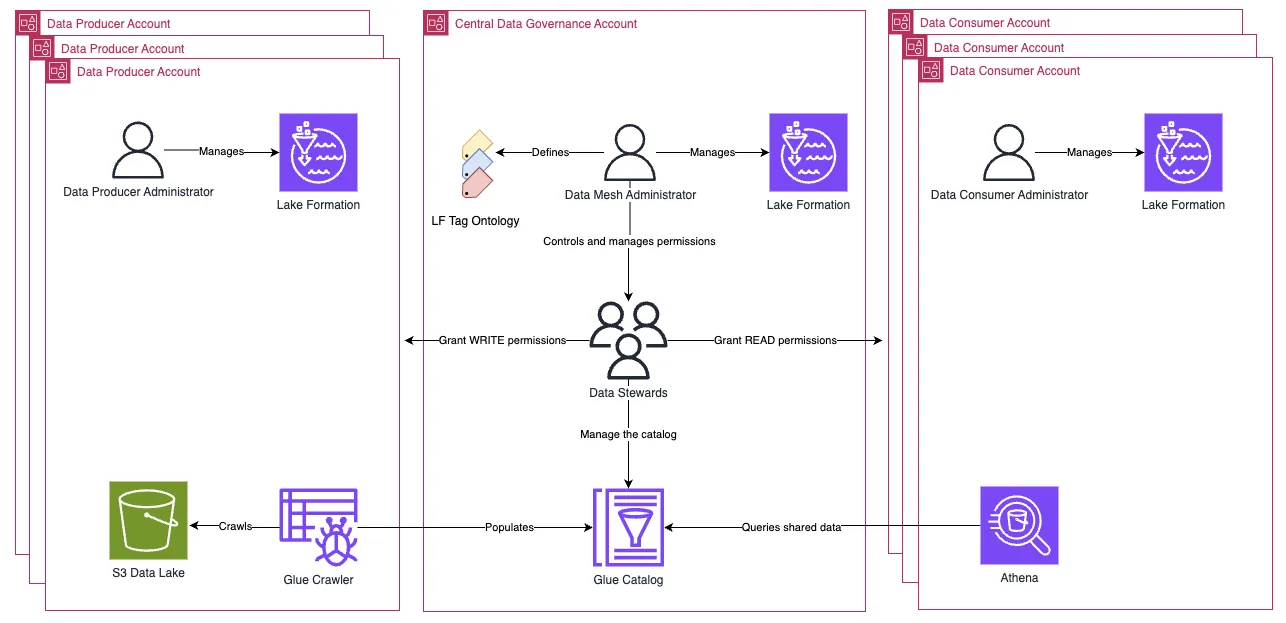 Figure 1. Enterprise data mesh on AWS, with administrators in each account and central data stewards routing write and read permissions across the central catalog.
Inside the broader AWS multi-account landing zone that Kite also delivered as part of the engagement, every component of the data mesh, including producer setup, central governance, and consumer setup, was defined as Infrastructure-as-Code in Terraform. Account onboarding, role provisioning, and Lake Formation configurations are versioned, reviewable, and reproducible.
The architecture is built on a small set of AWS services. AWS Lake Formation governs all catalog-level permissions and tag definitions, and the AWS Glue Data Catalog holds the metadata that producers populate and consumers query. Glue crawlers move table schemas from each producer’s S3 data lake into the central catalog, and Amazon Athena illustrates the consumer-side query path for reading shared data. AWS Identity and Access Management (IAM) provides the underlying role boundaries that Lake Formation grants extend.
How Tag-Based Access Changes the Equation
Before tag-based access, granting a data scientist access to a database meant writing a grant that referenced the database by name. Granting access to a table meant writing a separate grant that referenced the table by name. Adding a new consumer meant repeating that work for every relevant resource, and adding a new dataset meant repeating it for every relevant consumer. With n(P) as the number of consumer principals and n(R) as the number of resources, the number of grants required is n(P) × n(R). This is the named-resource model, and it is the source of the manual provisioning bottleneck.
Lake Formation Tag-Based Access Control (LF-TBAC) inverts the model. Instead of granting access to a named resource, an administrator attaches a tag to the resource and grants principals the right to read resources carrying that tag. Two operations replace the multiplicative join: attaching a tag to a resource, and granting a principal a tag expression. The total work scales to n(P) + n(R). The provisioning workload scales additively rather than multiplicatively, and new datasets and new consumers join the mesh without recomputing past grants. The mechanics are described in detail in the AWS Lake Formation tag-based access control documentation.
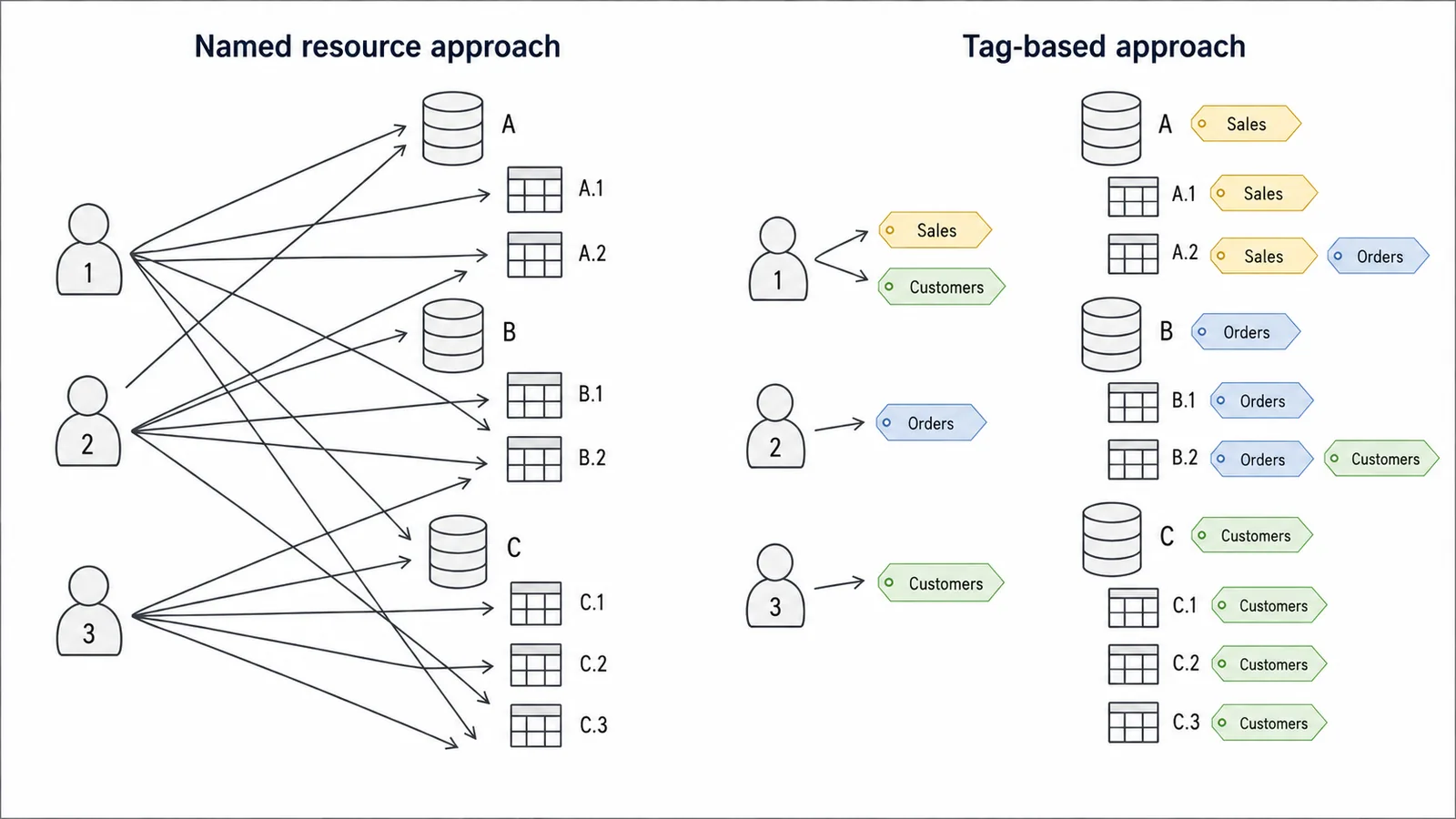 Figure 2. The named-resource approach compared to the tag-based approach.
The customer’s mesh started with three tag dimensions to express access intent. The sensitivity dimension carries values such as public, internal, confidential, and restricted, governing who is allowed to read a given resource. The domain dimension carries values along the lines of claims, policy, exposure, and actuarial, marking each resource with the business area that owns it. The tier dimension uses medallion values such as bronze, silver, and gold, where bronze is raw landing data, silver is cleaned and conformed, and gold is curated for direct consumption. A single tag-based grant can compose all three. Granting a model-training role access to sensitivity = confidential AND domain = claims AND tier = silver immediately delivers every existing claims dataset at that tier and sensitivity. It also extends to every future dataset that matches the same expression, as soon as a producer tags it. The vocabulary is designed to grow over time, with the central governance team adding new dimensions and values as the organization’s needs evolve.
This is what changed the equation for the customer. Scale was a hard requirement. The mesh was expected to grow to many producer domains and many consumer teams, and a model that needed a separate grant for every new dataset and every new consumer would not scale. Furthermore, governance remains centralized at the level of the tag vocabulary itself, which the central governance team owns. Ownership of the underlying data, and of the act of tagging it, remains decentralized with the producer domains.
Roles and the Data-Sharing Flow
Three types of groups operate the customer’s mesh, each defined by what it does inside it:
- The data producer team includes an admin who manages permissions inside the producer account, and a steward who works in the central catalog to tag the team’s datasets and grant access to consumers by tag expression.
- The central governance team includes the central governance admin, who defines and curates the tag vocabulary that every producer steward draws from.
- The data consumer team includes an admin who receives tagged data from producers and delegates downstream access to local analytics roles, such as analysts, data scientists, and AI engineers.
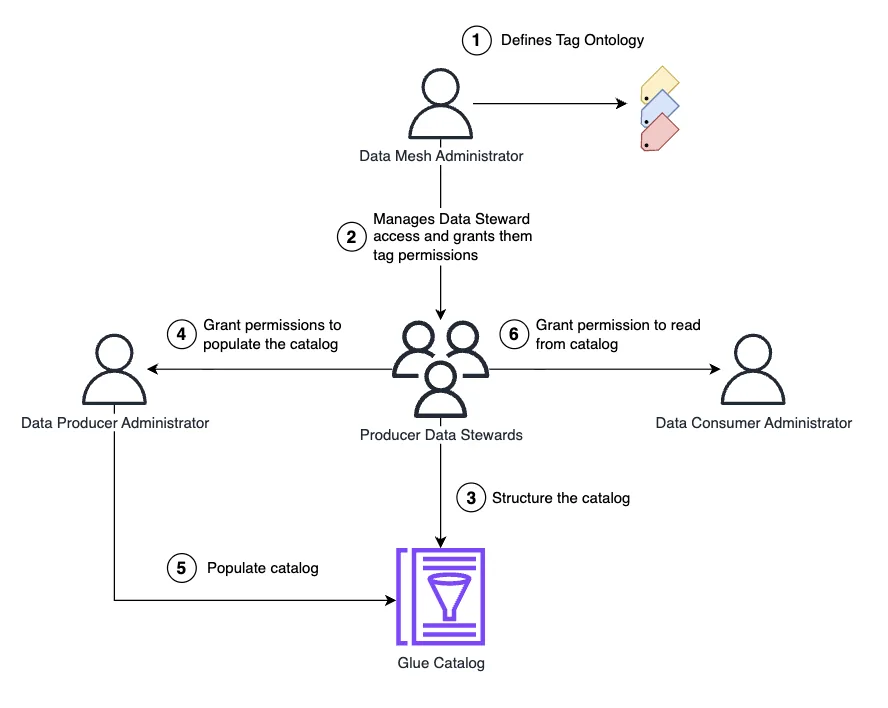 Figure 3. The permission flow through these roles, from the central governance admin’s tag vocabulary down to the producer and consumer admins on either side of the central catalog.
The flow begins with the central governance admin defining the tag vocabulary. The admin then grants the producer stewards permissions on those tags. The stewards structure the central catalog, attaching tag combinations to the databases and tables that describe their team’s data. They give the producer’s admin permission to populate the catalog, and the consumer’s admin permission to read from it. The producer’s admin populates the catalog, and the consumer’s admin propagates the read access to the team’s local roles.
Together, these roles make the mesh self-service for consumers and autonomous for producers, with minimal central work in between. The structure itself keeps security tight: each role carries only the access its function requires, and every grant is recorded centrally for review. Tagged datasets reach new consumers without case-by-case approval, and the same vocabulary scales as new producers and new consumers join.
Quantified Impact and Business Outcomes
The data mesh delivered a structural shift in how data reaches AI teams. Provisioning that used to take a multi-week chain of approvals and ticket exchanges now happens through a single tag-based grant. New consumer onboarding follows the same path, with no central case work required.
This unblocked AI model development across the organization. AI engineers and data scientists plan against the data they need without waiting for access. Model retraining cycles compress as datasets become routinely accessible, and exploratory work that was previously deprioritized is now affordable to attempt.
Governance scales additively rather than multiplicatively. Adding a new producer adds tagging and grants inside a single account. Adding a new consumer adds local delegation inside that account. Growing the mesh in both directions adds negligible work to the central governance backlog.
The mesh is audit-ready by construction. The Lake Formation grant log records who was granted which tag expression and when. The Terraform repository records every change to the mesh’s structural configuration. Together, these two surfaces give audit teams a single, defensible record of how data sharing was approved, applied, and updated over time.
| Impact Area | Before | After |
|---|---|---|
| Data access provisioning | Multi-week chain of approvals and ticket exchanges | Single tag-based grant, completed in minutes |
| AI model development cycle | Hampered by data delays | Accelerated by routine access to governed datasets |
| Governance scalability | Multiplicative growth with each new producer and consumer | Additive growth, new accounts join through the same tag vocabulary |
| Audit posture | Reconstructed from scattered tickets and manual reports | Audit-ready by construction, supported by Lake Formation grant logs and the Terraform repository |
About Kite Consult
Kite Consult is an AWS Advanced Tier Services Partner based in Germany. The team helps regulated and data-intensive organizations design and deliver secure cloud platforms on AWS, with practice areas spanning AWS landing zones, data lakes and data governance, AI enablement, security and compliance, and managed AWS services.
Planning a data platform for AI? Book a 30-minute call